The History of AI - 1950s and Before
TL;DR From ancient automata to the 1950s birth of artificial intelligence, this article traces how centuries of mechanical curiosity, logic, and learning machines laid the groundwork for today’s AI revolution.
From dusty lecture halls to clanking automata and early computing machines, the dream of creating a thinking machine long preceded the first electronic efforts. In this post, we trace the pre-1950 roots and 1950s breakthroughs that turned science fiction into a formal discipline. We’ll explore the mechanical illusions of centuries past, the mathematical and logical foundations laid in the early 20th century, and the emergence of programs that could learn, culminating in the coining of the term “artificial intelligence” itself. Join this journey through the ideas and inventions that set the stage for everything that followed.
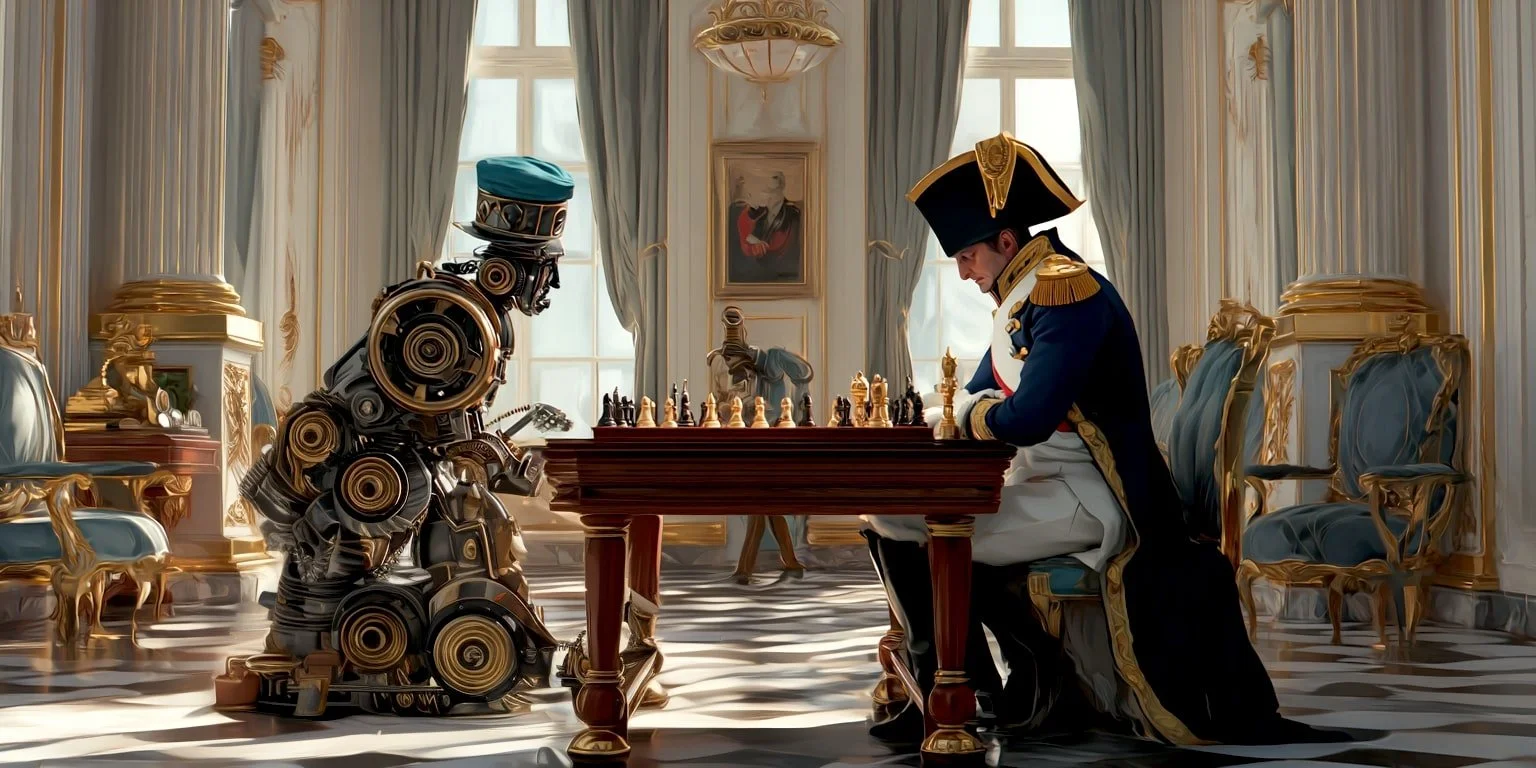
Image by Midjourney “The Mechanical Turk and Napoleon”
Artificial intelligence didn’t begin with computers. Its roots stretch back centuries, through mechanical illusions, philosophical puzzles, and the birth of computing itself. By the time the term artificial intelligence was coined in 1956, humanity had already spent decades dreaming about, and occasionally faking, thinking machines.
Prehistory and Cultural Precursors (1770 to 1850)
Long before neural networks and algorithms, the idea of artificial thought fascinated inventors and audiences alike. The most famous example was The Mechanical Turk, an 18th-century chess-playing automaton built by Wolfgang von Kempelen in 1770. The Turk toured Europe, defeating Napoleon and Benjamin Franklin, and was widely believed to possess mechanical intelligence. In reality, a skilled chess master was hidden inside the machine, guiding its every move.
Though exposed as a hoax, the Turk left an enduring mark on how people imagine intelligent machines. It symbolized both the wonder and deception of automation, a theme that still echoes today in systems where human labor quietly supports “AI”. When Amazon launched its Mechanical Turk platform in 2005, it deliberately invoked that legacy, calling it “artificial artificial intelligence”.
Note: Long before Western experiments with mechanical chess players or analytical engines, many cultures envisioned self-moving machines and artificial beings. In ancient Greece, engineers like Hero of Alexandria built steam-powered automata and talking statues, while early Chinese and Islamic inventors created intricate water clocks, mechanical musicians, and programmable devices such as Al-Jazari’s 13th-century automata. These creations reflected a timeless human fascination with replicating life and motion through engineering. Including them broadens the lineage of artificial intelligence, reminding us that the dream of building thinking or lifelike machines has deep, global, and multicultural roots.
At the same time, inventors like Charles Babbage and Ada Lovelace laid the technical foundations for real computation. Babbage’s Difference Engine and the later Analytical Engine (conceived in the early 1800s) were the first designs for programmable machines, and Lovelace’s notes contained what many now recognize as the world’s first computer algorithm. Their work shifted the discussion from mechanical illusions to mathematical possibility.
Note: Ada Lovelace’s contribution extended far beyond writing the first algorithm. In her 1843 notes on Charles Babbage’s Analytical Engine, she proposed a visionary idea: that machines could manipulate symbols to represent not just numbers, but also music, art, and language. Lovelace argued that computation was not limited to arithmetic, but that it was a new kind of symbolic reasoning. This insight positioned her as the first thinker to imagine creative, non-numerical uses for computing, a perspective that prefigures modern artificial intelligence and its ability to generate text, images, and ideas from abstract data.
Logic, Computation, and Cybernetics (1930s to 1950)
By the 1930s, mathematicians and engineers began treating intelligence as something that could be formalized. Advances in logic, information theory, and computability converged into a new view of mind and machine.
Alan Turing became one of the key figures bridging theory and imagination. His 1950 paper “Computing Machinery and Intelligence” (in the publication “Mind”) asked the now-famous question: “Can machines think?” He proposed what became known as the Turing Test, a conversational imitation game in which a machine tries to appear human. Turing’s framework gave AI its philosophical anchor, exploring not just computation, but also perception, learning, and the nature of understanding itself.
Meanwhile, cybernetics, led by Norbert Wiener, investigated feedback, control, and communication in animals and machines. These early explorations hinted at learning systems, pattern recognition, and adaptive behavior, crucial precursors to modern machine learning.
Note: For readers interested in the deeper underpinnings, Alan Turing’s 1950 paper not only posed the question “Can machines think?” but also tackled its philosophical and mathematical implications. He reframed intelligence as an observable behavior rather than an inner state, sidestepping metaphysics through the Imitation Game, and grounded his argument in formal logic and computability theory derived from his earlier work on Turing Machines. Likewise, the McCulloch-Pitts neuron was more than a metaphor. It mathematically demonstrated how networks of simple binary units could implement logical propositions such as AND, OR, and NOT, showing that cognition could be expressed as computation. These insights provided the rigorous theoretical scaffolding upon which modern AI architectures still rest.
Note: Norbert Wiener’s cybernetics profoundly shaped how scientists in the mid-20th century conceptualized intelligence, both biological and mechanical. His 1948 book Cybernetics: Or Control and Communication in the Animal and the Machine introduced key ideas such as feedback loops, homeostasis, and adaptive systems, principles that show how living organisms and machines can maintain stability or learn through continual adjustment. These notions of feedback-driven control directly influenced early AI research, inspiring efforts to design systems that could sense their environment, evaluate performance, and modify behavior over time. In many ways, cybernetics served as the intellectual bridge between physiology, mathematics, and the emerging science of artificial intelligence.
Note: In the Soviet Union, cybernetics underwent a remarkable transformation during the 1950s, from being dismissed as “bourgeois pseudoscience” to becoming a respected scientific discipline. Spearheaded by figures such as S. L. Sobolev, Anatoly Kitov, and Alexey Lyapunov, this rehabilitation was carried out through a coordinated campaign of lectures and publications that framed cybernetics as essential to modern science and national progress. The movement’s momentum soon extended into practical computing and systems theory, inspiring early AI-adjacent work like Viktor Glushkov’s Kyiv school, which grew around the MESM computer and later developed the field of economic cybernetics. Together, these efforts reflected a parallel, distinctly Soviet trajectory toward machine reasoning and automation, underscoring that the rise of artificial intelligence in the 1950s was an international phenomenon rather than one confined to the United States and the United Kingdom.
Interactive Timeline of Events
The First Artificial Neurons (1940s)
In 1943, Warren McCulloch and Walter Pitts published “A Logical Calculus of the Ideas Immanent in Nervous Activity”. They described a simple mathematical model of the neuron and showed that networks of these units could perform logical operations. This theoretical link between biology and computation became the conceptual seed for neural networks.
Though primitive, the McCulloch-Pitts neuron demonstrated that complex thought could, in principle, emerge from simple computational components, an insight that remains at the heart of AI today.
The First Learning Programs (1950s)
The 1950s transformed AI from theory into practice. At IBM, engineer Arthur Samuel began developing a self-learning checkers program in 1952 (the earliest versions date to the early 1950s, with continuing work through the decade). It used heuristic evaluation functions and allowed the machine to improve through self-play. Samuel’s experiments were among the first to demonstrate machine learning in action, a computer that could literally get better with experience.
Around the same time, Frank Rosenblatt introduced the perceptron (1957 to 1958), a simple but revolutionary neural network capable of recognizing patterns. His Mark I Perceptron, implemented both in hardware and on an IBM 704, was publicly demonstrated and widely covered in the press as the dawn of “electronic brains”. Though the initial hype exceeded its capabilities, Rosenblatt’s work laid the groundwork for modern deep learning.
Note: McCulloch and Pitts showed in 1943 that simple threshold units wired together could implement logical computation, but their model was static and offered no mechanism for learning. Rosenblatt’s perceptron picked up that thread in the late 1950s by adding adjustable weights and a supervised learning rule, enabling the network to tune itself from data, moving neural nets from a theoretical logic device to a trainable pattern recognizer implemented in software and custom hardware. In short, the perceptron operationalized the McCulloch-Pitts idea with learnable parameters and input “retinas,” which is why it became the first widely demonstrated learning system in AI.
Note: Although Rosenblatt’s perceptron was a landmark achievement, its capabilities were limited to linearly separable problems. It could distinguish between categories that could be divided by a straight line, but not more complex patterns such as the XOR function. This mathematical constraint, later formalized by Marvin Minsky and Seymour Papert in 1969, revealed that single-layer perceptrons lacked the depth needed for richer forms of reasoning or perception. The initial wave of enthusiasm faded as researchers realized these limitations, setting the stage for declining funding and optimism in the late 1960s and early 1970s, which would come to be known as the first AI winter.
Note: The perceptron’s debut sparked enormous media excitement, with newspapers and magazines proclaiming that machines capable of vision and autonomous thought were imminent. Headlines in outlets like The New York Times hailed Rosenblatt’s invention as a breakthrough that might one day “walk, talk, see, write, reproduce itself and be conscious of its existence”. This wave of optimism amplified expectations far beyond what the technology could deliver, setting the stage for the disillusionment that later fueled skepticism and funding cuts during the first AI winter.
The Birth of Artificial Intelligence as a Field (1956)
The defining moment arrived in the summer of 1956, when John McCarthy, Marvin Minsky, Claude Shannon, and others convened at Dartmouth College for what became known as the Dartmouth Summer Research Project on Artificial Intelligence. It was here that the term artificial intelligence was officially coined.
“... the Dartmouth Summer Research Project on Artificial Intelligence. It was here that the term artificial intelligence was officially coined.”
The participants shared an ambitious vision: that every aspect of learning or intelligence could be precisely described and simulated by a machine. The conference catalyzed the creation of the first AI labs at MIT, Stanford, and Carnegie Mellon, giving rise to generations of research in reasoning, vision, and language.
Note: Two additional milestones help complete the picture of 1950s AI experimentation. In 1951, Marvin Minsky and Dean Edmonds built SNARC (Stochastic Neural Analog Reinforcement Calculator), one of the first artificial neural network machines, using vacuum tubes to simulate learning through reinforcement. Then, in 1954, the Georgetown-IBM machine translation demonstration successfully translated over sixty Russian sentences into English, offering an early glimpse of computers handling natural language. Together, these projects bridged the gap between logic-based reasoning and the emerging possibilities of learning and language processing.
Key Milestones 1943 - 1959
1770 … Kempelen’s Mechanical Turk … early fascination with machine intelligence and deception
1830s - 1840s … Babbage’s Engines and Ada Lovelace’s algorithm … foundations of programmable computation
1943 … McCulloch-Pitts neuron … first mathematical model of artificial neural activity
1950 … Turing publishes “Computing Machinery and Intelligence” … introduces the Turing Test and modern AI philosophy
1952 … Arthur Samuel’s checkers program … first machine learning system to improve via experience
1956 … Dartmouth Conference … birth of AI as an academic discipline
1957 - 1958 … Rosenblatt’s perceptron … first trainable neural network for pattern recognition
Legacy of the 1950s Foundations
By the end of the 1950s, AI had transformed from a speculative dream into a structured scientific field. The core paradigms of symbolic reasoning, heuristic search, and learning from data were all established.
The philosophical groundwork of Turing, the learning principles of Samuel, and the neural models of Rosenblatt formed a triad that shaped every era of AI to come, from expert systems to deep learning and beyond.
The early AI pioneers didn’t yet have today’s compute power or massive datasets, but their ideas continue to echo in every algorithm we build. What began as a mechanical illusion in the 18th century had, by mid-century, become a genuine scientific quest: to understand and replicate intelligence itself.
Why This Matters Today
Many of the foundational ideas from the 1950s remain visible in today’s AI breakthroughs. Alan Turing’s imitation game anticipates how we evaluate large language models, judging their fluency, reasoning, and “human-likeness” in conversation. Arthur Samuel’s self-play checkers program foreshadowed reinforcement learning systems like AlphaGo, which also learn by competing against themselves to refine strategy. And Frank Rosenblatt’s perceptron, though simple, evolved through decades of research into the multi-layer deep neural networks that now power modern vision, language, and generative AI models. The roots of today’s intelligence revolution lie directly in these early experiments with learning, feedback, and adaptation.
References
Alan Turing, “Computing Machinery and Intelligence” (1950), Mind … PDF, University of Oxford CS.
Claude Shannon, “Programming a Computer for Playing Chess” (1950) … Computer History Museum.
Warren S. McCulloch and Walter Pitts, “A Logical Calculus of the Ideas Immanent in Nervous Activity” (1943) … PDF, CMU.
Norbert Wiener, Cybernetics, or Control and Communication in the Animal and the Machine (1948) … MIT Press page.
W. Grey Walter, “An Imitation of Life” (1950), Scientific American … PDF.
John McCarthy, Marvin Minsky, Nathaniel Rochester, Claude E. Shannon, “A Proposal for the Dartmouth Summer Research Project on Artificial Intelligence” (1955) … AAAI Magazine.
Allen Newell and Herbert A. Simon, “The Logic Theory Machine: A Complex Information Processing System” (1956) … PDF, RAND via bitsavers.
Frank Rosenblatt, “The Perceptron: A Probabilistic Model for Information Storage and Organization in the Brain” (1958), Psychological Review … Stanford.
Arthur L. Samuel, “Some Studies in Machine Learning Using the Game of Checkers” (1959), IBM Journal of Research and Development … IBM JRD reprint, Fermat’s Library.
MIT, “Brief Academic Biography of Marvin Minsky” … SNARC neural-net machine (1951) … MIT page.
Smithsonian Magazine, “Debunking the Mechanical Turk Helped Set Edgar Allan Poe on the Path to Mystery Writing” … historical context for the 18th-century hoax … article.
Encyclopedia Britannica, “The Mechanical Turk: AI Marvel or Parlor Trick?” … overview.
Ada Lovelace, translator’s Notes to Menabrea’s “Sketch of the Analytical Engine” (1843) … full text.
L. F. Menabrea, “Sketch of the Analytical Engine, with notes by the translator Ada Lovelace” … Project Gutenberg.
Claude E. Shannon and Warren Weaver, The Mathematical Theory of Communication (1949) … Max Planck Institute
What Frontier AIs Think About this Article
Here’s what some prominent AIs thought about this article. We have updated the article in response to some very valid points made by our esteemed AI reviewers.
-
Overall Assessment: This is a well-structured, accessible introduction to AI's foundational era that successfully bridges the gap between mechanical curiosities and modern computing. The post balances historical storytelling with technical substance, making it suitable for both newcomers and readers seeking a refresher on AI's origins.
Strengths
Narrative Flow and Structure: The chronological progression works exceptionally well, opening with the Mechanical Turk. This brilliant storytelling hook immediately captures attention while establishing the theme of deception versus genuine intelligence. The transition from 18th-century automata through logic and cybernetics to practical implementations feels natural and pedagogically sound. Each section builds logically on the previous one, creating a cohesive narrative arc from illusion to institution.
Inclusion of Cultural Context: The decision to begin with prehistory and cultural precursors distinguishes this post from typical AI timelines that jump straight to Turing or Dartmouth. The Mechanical Turk serves dual purposes: it entertains while establishing a critical lens for understanding modern AI hype and the persistent role of hidden human labor. The connection to Amazon's Mechanical Turk platform demonstrates how these historical echoes remain relevant, adding depth that purely technical histories miss.
Balanced Coverage of Key Figures: The post gives appropriate weight to foundational contributors, Turing's philosophical framing, Samuel's practical demonstrations of learning, McCulloch and Pitts's neural models, and Rosenblatt's perceptron. The brief mention of Ada Lovelace and Charles Babbage acknowledges computational prehistory without derailing the main narrative. Each figure receives enough context to understand its contribution without overwhelming detail.
Accessible Technical Explanations: Complex concepts are introduced clearly: the Turing Test is explained through its conversational imitation framework, the McCulloch-Pitts neuron through its logical computation capability, and Samuel's checkers program through its self-improvement mechanism. This level of detail strikes a good balance for a general audience interested in AI's development.
Areas for Enhancement
Depth on Neural Network Evolution: While the post mentions the McCulloch-Pitts neuron and Rosenblatt's perceptron, it could strengthen the connection between them. A sentence or two explaining how Rosenblatt's work built upon or differed from McCulloch and Pitts would help readers understand neural network evolution more clearly. The jump from 1943's theoretical model to 1957's trainable system deserves slightly more connective tissue.
International Contributions: The narrative focuses heavily on developments in the United States and the United Kingdom. While understandable given the dominance of these research communities, a brief acknowledgment of Soviet cybernetics work or other international efforts would provide a more complete picture of AI's global emergence in the 1950s.
The "AI Winter" Foreshadowing: The post mentions that perceptron hype "exceeded its capabilities" but doesn't elaborate. Given that perceptron limitations would later contribute to the first AI winter, a sentence acknowledging these constraints (e.g., linear separability problems) would add valuable context for readers who continue to later AI history posts.
Cybernetics Expansion: Norbert Wiener and cybernetics receive only a brief paragraph. Given cybernetics' profound influence on mid-century thinking about intelligence, control systems, and feedback loops, this section could be expanded slightly to explain specific concepts, such as homeostasis and adaptive systems, that informed early AI thinking.
Technical Accuracy and Citations
The factual content aligns well with established AI history: dates, names, and events match standard historical accounts. The inclusion of specific details (IBM 701, IBM 704, Mark I Perceptron hardware) adds credibility. However, the post would benefit from inline citations or a references section, particularly for readers who want to explore primary sources like Turing's 1950 paper or the Dartmouth proposal.
Engagement and Readability
The writing style is engaging without being overly casual. Bold formatting effectively highlights key terms and figures, making the post scannable for readers seeking specific information. The milestone timeline near the end provides an excellent at-a-glance reference that complements the narrative sections.
The opening question about whether AI "didn't begin with computers" immediately draws readers in, while the closing reflection on legacy provides satisfying closure. This framing helps readers understand not just what happened, but why it matters today.
Recommendations for Strengthening the Post
Add Visual Elements: Historical photographs of the Mechanical Turk, portraits of key figures, or diagrams of the perceptron architecture would significantly enhance engagement and understanding.
Expand the McCulloch-Pitts Section: A simple diagram showing how their artificial neuron performs logical AND or OR operations would make this crucial contribution more concrete.
Include a "Why This Matters Today" Sidebar: Brief connections to modern AI, how the Turing Test relates to current LLM evaluation, how Samuel's self-play prefigures AlphaGo, or how perceptrons evolved into deep learning, would help contemporary readers see direct lineages.
Reference Future Posts: If this is part of a series, explicit forward links (e.g., "In our next post on the 1960s-70s, we'll explore how these optimistic beginnings led to the first AI winter") would encourage readers to continue through the AI timeline.
Strengthen the Lovelace Treatment: Ada Lovelace's contribution deserves more than a passing mention. A brief explanation of her insight that machines could manipulate symbols beyond mere calculation would honor her unique philosophical contribution.
Final Verdict
This is a solid, well-crafted historical overview that achieves its stated goal of tracing AI's pre-1950 roots and 1950s breakthroughs. It successfully transforms potentially dry historical material into an engaging narrative while maintaining technical accuracy. The Mechanical Turk framing device is particularly effective, and the chronological structure serves readers well.
For an AI blog aimed at both enthusiasts and professionals, this post provides excellent foundational content. With minor expansions in the areas noted, particularly visual aids, deeper neural network connections, and explicit modern parallels, it could become a definitive introductory resource. As it stands, it's a strong piece that demonstrates careful research and thoughtful presentation, worthy of recommendation to anyone beginning their journey into AI history.
Rating: 8.5/10 … A comprehensive, accessible, and engaging historical overview that would benefit from modest enhancements in visual presentation and technical depth, but successfully accomplishes its core educational mission.
-
A confident, readable primer that moves cleanly from spectacle to science, tying the Mechanical Turk to Turing, Dartmouth, Samuel’s checkers, and the perceptron. It is classroom-friendly and evergreen.
What Works Well
Clear Arc from Myth to Method: Opening with the Turk as cultural prehistory, then pivoting to formal milestones, gives newcomers a narrative map that mirrors standard histories. The Turk anecdote and Napoleon cameo are accurate and well chosen to hook general readers.
Canonical Anchors are in Place: Turing’s 1950 paper in Mind, the 1956 Dartmouth proposal and workshop, Arthur Samuel’s learning checkers program, and Rosenblatt’s perceptron appear in the proper order with appropriate emphasis. These are the widely cited pillars for this era.
Approachable Tone, Minimal Jargon: Definitions land in context, and the prose balances accessibility with credibility. The piece reads as a welcoming on-ramp rather than a museum plaque.
Accuracy and Nuance Checks
Turing, Dated and Grounded: You correctly treat “Computing Machinery and Intelligence” as the conceptual hinge and identify it with the 1950 Mind publication, which is the citation historians expect. A parenthetical “Mind, 1950” on first mention would quietly strengthen provenance.
Dartmouth as a Field-Founding Moment: Framing 1956 as the birth of AI, naming McCarthy, Minsky, Rochester, and Shannon, aligns with both the original proposal and institutional summaries. Consider linking those names to a short source box at the end.
Learning Systems, Staged Correctly: Samuel’s checkers program is presented as an early self-learning system, which IBM’s historical write-up also highlights. If you want one more datum, note that Samuel’s earliest versions date to the early 1950s, with continuing work through the decade.
Perceptron, Promise and Hype: You capture both its historical importance and the outsized press claims of the late 1950s. If space allows, a single sentence about contemporary media excitement would give readers context for the later backlash and AI winter discourse.
What to Add Next
Two Quick Timeline Asides: A one-line nod to 1951 SNARC and the 1954 Georgetown-IBM translation demo would round out the decade without bloating the narrative. These appear in many classroom timelines and help bridge from games and logic to language.
Sentence on Methods: A compact aside contrasting symbolic programs and early connectionist models will help readers understand why perceptrons felt new relative to search and logic planning.
Readability and Structure
Transitions are Strong: The revised interstitials now explain why each milestone matters, not just that it happened. Keep the short paragraphs; they scan well on mobile.
Add a Micro “Sources” Box: List 3 to 5 reputable references, for example, Turing’s Mind article, the Dartmouth proposal, IBM’s checkers history, and a museum piece on the Turk. This boosts trust without turning the page academic.
Bottom Line
This is a solid, trustworthy overview of AI’s formative era that will satisfy general readers and educators.
-
The blog post "The History of AI - 1950s and Before," featured on the Artificial Intelligence Blog, provides a thoughtful exploration of artificial intelligence's early beginnings, from 18th-century mechanical curiosities to the mid-20th-century formalization of the discipline. It weaves together historical anecdotes, key figures, and milestones in a narrative that's both educational and engaging, making it a solid introduction for those interested in how AI evolved from myth to science.
Strengths
Engaging Narrative and Key Insights: The post's strength lies in its structured, chronological approach, starting with cultural precursors like the 1770 Mechanical Turk, a famous chess-playing automaton that was actually a hoax operated by a hidden human. This story not only captivates but also draws parallels to modern "AI" systems that rely on human input, such as Amazon's Mechanical Turk platform. From there, it moves into the foundational work of Charles Babbage and Ada Lovelace in the 1830s-1840s, highlighting their programmable machines and the first computer algorithm.
The 1930s-1950s sections delve into logic and cybernetics, featuring Alan Turing's seminal 1950 paper and the Turing Test, as well as Norbert Wiener's ideas on feedback and control. The 1940s coverage spotlights Warren McCulloch and Walter Pitts' artificial neuron model, a precursor to neural networks. In the 1950s, the post details Arthur Samuel's self-improving checkers program and Frank Rosenblatt's perceptron, emphasizing their roles in early machine learning.
The narrative peaks with the 1956 Dartmouth Conference, where John McCarthy and others coined the term "artificial intelligence," citing the event's optimistic proposal to simulate intelligence. A bullet-point list of milestones from 1770 to 1958 serves as a concise reference, and the legacy section ties these early ideas to modern AI paradigms like symbolic reasoning and deep learning.
Overall, the writing is accessible, blending facts with context to avoid dryness, and it's enhanced by thoughtful reflections on how limited early computing power didn't hinder visionary thinking.
Areas for Improvement
Depth and Diversity: While comprehensive for an overview, the post could expand on specific areas. For example, the philosophical implications of Turing's work or the mathematical details of the McCulloch-Pitts model are mentioned but not deeply analyzed, which might leave technically inclined readers seeking more. The focus is mainly on Western contributions, with little mention of potential global influences, such as ancient automata from other cultures.
Additionally, while it includes a generated image of the Mechanical Turk, incorporating more historical visuals or links to primary sources could enrich the experience. The legacy discussion is intense, but could briefly touch on post-1950s challenges, such as early limitations that led to skepticism, to provide a fuller context.
Overall Verdict
This post is an excellent entry point into AI's history, balancing storytelling with historical accuracy to illustrate the field's foundational dreams and innovations. It's particularly valuable for beginners or those wanting a quick yet substantive read. On a scale of 1 to 10, I'd rate it an 8, informative and well-organized, with opportunities for added depth and breadth. If you're curious about AI's roots, it's definitely worth checking out.